Research

My group develops statistical learning and signal processing methods for settings where labels are scarce or unreliable, data are large, and information comes from many sources. Our work is supported in part by the National Science Foundation. Each project page below summarizes the problem and links to the related papers.

Learning with noisy labels and crowdsourcing

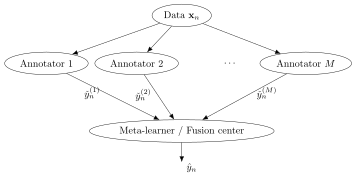
An umbrella for our work on labels that cannot be trusted: blind ensemble learning, robust crowdsourcing in the presence of spammers and adversaries, and constrained crowdsourcing that exploits side information.
crowdsourcing, ensemble learning, weak supervision, robustness

Self-supervised and semi-supervised learning

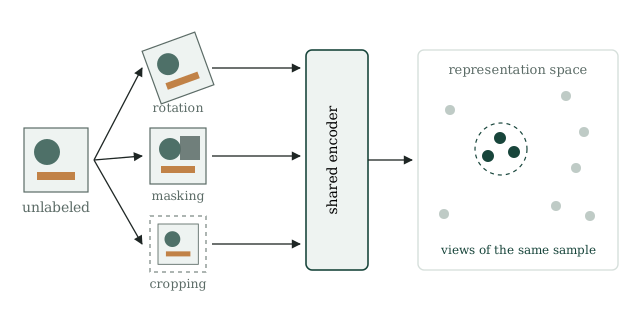
Building useful representations from unlabeled data by combining several self-supervised tasks, and using them when labels are scarce, including physics-informed representations for power networks.

self-supervised learning, representation learning, few labels

Learning over graphs

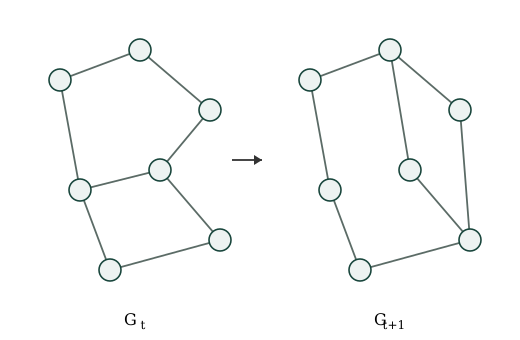
Fast spectral embeddings for graphs that evolve over time, inference of the network topology itself, and robust learning when the graph is corrupted or attacked. Supported by the NSF project Robust Learning over Graphs.

graph learning, embeddings, anomaly detection, robustness

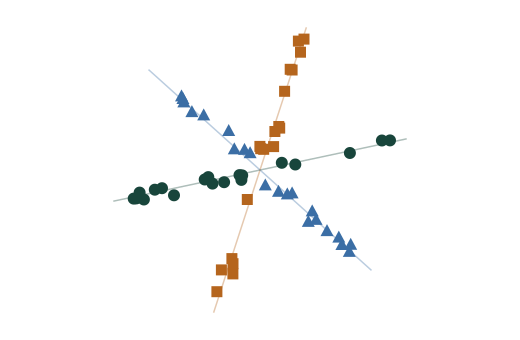
Scalable subspace clustering

Clustering large, high-dimensional datasets that lie near a union of low-dimensional subspaces, using random sketching, sampling and distributed computation.

clustering, big data, randomized algorithms

No matching items