Self-supervised and semi-supervised learning
Overview
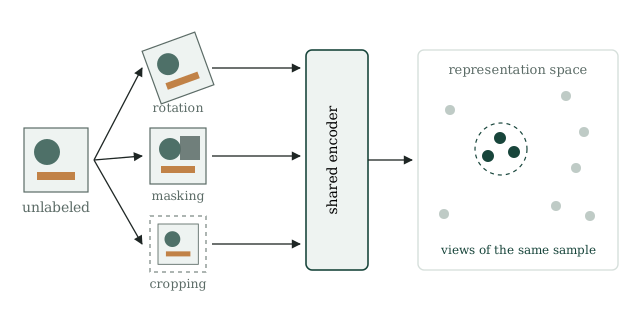
Self-supervised learning creates its own training signal from unlabeled data through pretext tasks, and the resulting representations are then used for downstream tasks. Different pretext tasks capture different aspects of the data, and no single one is best for every downstream task.
Approach
We study how to aggregate multiple self-supervised tasks rather than commit to one, connecting this to our work on ensembles, and how the resulting representations improve semi-supervised learning when labels are scarce.
Physics-informed representations
In engineering systems, the pretext task need not be generic: physical models and simulators supply structure that a learner can exploit where labeled measurements are few. With collaborators we use this idea for power networks, transferring knowledge from physics-based models to predict voltage stability margins.
Key papers
- A. Chudda and P. A. Traganitis, “Aggregating Multiple Self-Supervised Tasks for Robust Semi-Supervised Learning,” Proc. of Asilomar Conf. on Signals, Systems, and Computers, Pacific Grove, CA, 2026.
- K. D. Polyzos, P. A. Traganitis, M. K. Singh and G. B. Giannakis, “Ensembles of Informative Representations for Self-Supervised Learning,” Proc. of IEEE MLSP, London, UK, 2024. (Best paper award, second place)
- M. K. Singh, K. D. Polyzos, P. A. Traganitis, S. V. Dhople and G. B. Giannakis, “Physics-Informed Transfer Learning for Voltage Stability Margin Prediction,” Proc. of ICASSP, Rhodes, Greece, 2023.